
Alberta used Single Transferable Voting (STV) in Calgary and Edmonton—why did we get rid of it?
How Alberta Ended Up with PR in the 1920s
In 1921, the United Farmers of Alberta won a majority of the seats in the Alberta provincial election. They had promised electoral reform. The form they introduced was:
- Districts with multiple MLAs elected for Edmonton (5), Calgary (5), and Medicine Hat (2)
- A ballot by which voters ranked the candidates by preference
But they also left all the other districts to be single MLA districts.
The effect was immediate and positive. Whereas in the 1921 election, all five seats in Edmonton went to the Liberals, in the next election in 1926, the results were:
| MLA | Party |
| Hon. F. J. Lymburn | United Farmers of Alberta |
| C. Y. Weaver | Conservative |
| C. L. Gibbs | Labour |
| W. W. Prevey | Liberal |
| D. M. Duggan | Conservative |
Now there’s some diverse representation! We can only imagine that Edmontonians were better pleased with actually getting the types of MLAs they wanted.
This voting system continued through until 1955. Medicine Hat had dropped down to one MLA, so the system became less effective there. But Calgary had 6 MLAs and Edmonton 7, which made for a good variety of MLAs from the following parties in the 1955 results for the two cities:
| Edmonton | Calgary |
| Social Credit (3) | Social Credit (3) |
| Liberal (2) | Liberal (3) |
| Conservative (1) | Conservative (1) |
Political Pushback and the Return to FPTP
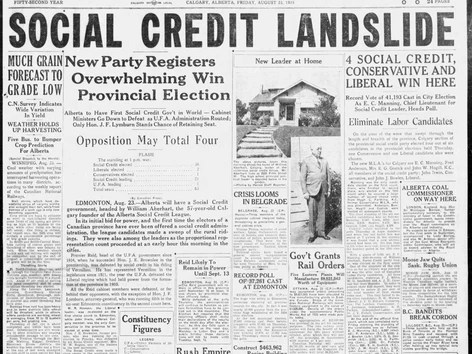
The Social Credit party was feeling uneasy. They weren’t enjoying the same success that had been used to after being in power since 1935. What’s more, because not all district elected multiple MPs, Social Credit had a majority in the Legislature based on its winnings in rural one-MLA districts.
It used this unfounded majority of seats to change the Alberta voting system to single-member districts using first-past-the-post.
And so Alberta lost its tenuous grasp on good voting.
The immediate effect was dramatic: in the very next election, Social Credit won all the Edmonton seats and all but one in Calgary, which they lost to a new party, the Progressive Conservatives.
Hubris had its day. In 1971, the PCs took the majority of the seats (49 of 75), and by the 1976 election, Social Credit was all but finished, with just 4 seats.
Instead of the PCs being incorporated into the political life of Alberta and Social Credit continuing to make its contribution—what would have happened had Alberta had multi-member districts and Single Transferable Voting across the province—the old party disproportionately lost and the new one disproportionately won. It made it look like a catastrophic change, which was not the case.
Is PR Dangerous? Alberta’s History Says Otherwise
People sometimes claim that a more proportionate voting system allows extremists to come to life and thrive, when, in fact, there’s nothing more extreme than a new party getting just 5.3% more votes than their rival, but gaining 100% of the legislative power.
Alberta had better. And we can have it again.
 Fair Vote Canada - Edmonton Chapter
Leave a comment